5 of the Best Oxford Comebacks

We take a look back at five of the most spectacular comebacks available on the internet.

Read More

The Curse of the Kassam?

A pair of articles examining Oxford's poor home form and speculating on the reasons why. In the first we lay the blame on the counter-attacking system. In the second, we examine the role of the home fans.

Article 2 Article 1

The Future's Bright

Oxford's under-18s outclass their Swindon counterparts, leaving your writer purring over their future prospects in the first team.

Read More

The Importance of Width in League Two

Why Sean Rigg and Alfie Potter's form will be essential to our hopes of League Two promotion this season.

Read More

We'll Win Nothing With Kids?

We look at whether the young development squad players are ready to step up to first team action.

Read More

Showing posts with label MANAGEMENT. Show all posts

Wednesday, 9 October 2013

Oxford's Split Personality

The League Two season is now ten games old – a point which is widely recognised as the time to review the start we have made to the season. By this point in the season the table has begun to take some shape, promotion contenders and relegation candidates materialise and patterns have begun emerge.

At the ten-match mark we find ourselves fourth in the table, outside the automatic promotion places by two points. It's a decent position to be in and puts us in a good position to push on and challenge this season but a concerning trend has emerged, albeit a not-unexpected one. Of course, the issue on everyone's lips at the moment is the team's home form.

It's something which has been debated extensively on Yellows Forum and on the excellent Oxpod United podcast and a veritable cavalcade of explanations have been posited, from negative fans to away teams raising their game at the Kassam. It's an issue that's come to dominate all talk of the club but one I've been reluctant to wade into, mainly due to the fact that I've already written about it last season. However, at the risk of repeating myself, it would be impossible to review the season so far without reference to this unusual phenomenon.

In the simplest of terms, Oxford appear to be a completely different side away from home than we are at home. On the road, we are clinical, free-scoring and relatively solid at the back (only Fleetwood and Mansfield have conceded fewer goals than us away). At home, it's a completely different story: only struggling Hartlepool and Accrington have scored fewer goals than we have on their own ground and matches at the Kassam frequently descend into dreary morale-sapping experiences as United struggle to find any rhythm to break down the opposition.

Away

Home

The level of support or the expectations of the fans shouldn't be a factor. Look at small, moneyed clubs like Crawley - expectations are high but supporters are low and it seems to have no effect on their performances. This season has put paid to the popular myth from last season that the state of the pitch was responsible for our poor home form - London Welsh have only played once at the Kassam so far this season. Having a 'nice' stadium isn't the problem either; Rotherham had a brand-new stadium last year which was a lot better than ours and they won promotion and Chesterfield's stadium is much newer and shinier than the Kassam and they have no problems at home.

In my opinion, the reason for our inability to perform at home is not due to the atmosphere or the pressure the players are under, it's something far simpler. The team are set up to be a very good counter-attacking outfit, but when it comes to taking the initiative and breaking opposing sides down we frequently struggle.

This is borne out by the stats. According to the (admittedly not-too-reliable) possession statistics listed on the club's official website, we have enjoyed the majority of possession on just two occasions this season. Clearly that's not because we're being outplayed by our opponents, it's because the team is set up allow our opponents to see a large amount of the ball and then hit them when the openings appear. This is a tactic which will naturally lend itself better to away matches but it's not going to work so well against other teams who are looking to do similar to us at our place – Southend on Saturday being a prime example (for the record, the Shrimpers had just 38% possession in that match).

Oxford are probably the best team in League Two without the ball, but clearly we need to be better with it. Despite losing, I saw some positive signs against Portsmouth that we are still capable of imposing ourselves on sides when they come to the Kassam but we clearly lacked that cutting edge that has made us so clinical on our travels. Nevertheless it gives me some hope that we can change our style of play at home and we'll have to if we want our form to improve.

We don't need to be fantastic at home to win promotion from this league, as the current table demonstrates, just a slight improvement will be enough to get us over the line. Gillingham won the league last season despite losing six and drawing five of their home matches last season – including a 1-0 defeat to us. That said, if home crowds are to improve from their average of 6,180 we are going to have to start getting results and entertaining fans. That's not so easily solved...


Share this

Wednesday, 25 September 2013

The Importance of Width in League Two

Sean Rigg
Picture by Jon Whiles Photography
At the top level of the game the debate continues to rage about whether the traditional winger as we know it is dead. The success of Spain at international level with their unorthodox and much-vaunted 4-6-0 approach and the increasing popularity of the narrow 4-2-3-1 among Europe's top clubs have combined to push the old tried-and-true 4-4-2 well and truly out of favour – and with it everyone's favourite player: the winger.

But Oxford don't play at the top level of the game and they aren't one of Europe's top clubs (yet!), so emulating Barcelona isn't necessarily likely to bring results in League Two. Having won promotion from the Conference by utilising a direct approach that involved getting the ball up to the front three of James Constable, Jack Midson and Matt Green as quickly as possible, Chris Wilder jettisoned this approach upon the club's return to the Football League. Overhauling the squad in the summer of 2010, Oxford were set up with a continental narrow 4-3-3 formation and an emphasis on passing football and ball retention. The result was a side which played some beautiful football and finished 12th. Clearly a rethink was needed.

The sad fact is that at our level of football the players are too limited to make such a fluid approach work successfully. Instead the 4-4-2, for all its faults, is a system which all the players are used to and comfortable with and as a result they perform better. The intervening years between those early League Two lessons and now have seen a lot of tinkering and experimenting as Wilder has tried to hit upon the magic formula for success, and although there probably is no single approach that guarantees promotion one thing that has stood out in recent seasons is that good wing play can be a major factor in a side's success at League Two level.

Take Port Vale last season as a notable example. Lots of people pinpointed the impressive goalscoring form of Tom Pope as the reason for Vale's unexpectedly successful season, but he was only able to find the net so often because there was a steady supply of chances landing at his feet (or on his head or anywhere else really), most of which came from the wingers. Ashley Vincent and Jennison Myrie-Williams were a devastating force last season, as demonstrated when they were allowed to roam free during the 3-0 demolition they inflicted on us at Vale Park.

The importance of quality wide players was emphasised again on Saturday when Chesterfield ended our unbeaten start to the season. Of course, when you've assembled a squad like theirs it's easy to look good but as we're discussing style of play rather than personnel I think they still serve as a very strong example of how to play at this level. Chesterfield constantly look to stretch the play and get their wide players on the ball and as a result Gary Roberts and Tendayi Darikwa gave our full-backs trouble all afternoon. Most Oxford fans agreed that Chesterfield were the best side we're likely to come up against this season and part of the reason for that success is the way they use the flanks. Their goal on Saturday, for example, came from a ball in from the left.

Alfie Potter
Picture by Jon Whiles Photography
And then, of course, there's us. With Alfie Potter and Sean Rigg we have two of the best wingers in League Two within our ranks. When both are fit and we really utilise the width they offer they can be unstoppable – as they were at Portsmouth on the opening day of the season. Rigg's injury perhaps highlighted how fundamental the wingers are to our chances this season, with just one win from the four matches he missed (not including Torquay and Chesterfield, both of which he played some part in). We've already touched on this point when discussing Oxford's younger players, but by replacing Rigg with the naturally central Asa Hall our attacking potential was considerably reduced.

This lack of cover out wide – particularly if O'Dowda isn't considered ready for first-team football yet – is possibly my biggest concern about the team at the moment. Rigg and Potter won't play every match this season, and being wingers they won't necessarily play brilliantly in every match either, so we need more options that can come on and deputise to ensure that we maintain a wide threat. That could be the difference between the flashes of brilliance we've seen so far and a consistently strong season.


Share this

Monday, 29 July 2013

Twin Goals for Oxford this Season

“Failure to win promotion this season will be a disaster.”

We've all heard that phrase, or some form of equivalent, before. Inevitably it gets an airing at some stage every season and yet, after several seasons of failing to win promotion the club is still standing and, most importantly, still able to raise a competitive side in League Two. But by forcing ourselves to believe that every season is a potentially pivotal one in the history of the club are we piling unnecessary pressure on ourselves? It seems this kind of attitude remains something of a hangover from the Conference days, when the future of the club really was at stake - but is it any more? If the club remains at this level for too long with little sign of being promoted then, yes, its potential to grow will be stunted, but this is a gradual process over a number of years, not dependent on the result of one season.

Which is all a rather roundabout way of saying that the season ahead is important (as they all are) but not necessarily a pivotal one as far as the club's future is concerned. Promotion is again expected, and rightly so, but if we fail to achieve it the club will still be here next year. However, for one person in particular this season really is pivotal. If it turns out to be similar to the last one it seems difficult to believe that Chris Wilder will still be in the hotseat and preparing for another shot at promotion in 2014-15.

For a large section of the Oxford support, patience with Wilder dried up at some point during the last campaign. It was indeed a dreary, morale-sapping season with very few highlights and it's unsurprising that some of the supporters got a little tetchy. This summer's transfer dealings have certainly restored the faith among quite a few of those fans, but make no mistake that patience is most definitely not a virtue the United 'faithful' possess in droves at the moment and a poor start to the season could result in the atmosphere around the ground becoming poisonous very early into the season. The 'Wilder out campaign' has been noticeably quiet during the summer months, but it won't take much for those rumblings to stir once again. Fortunately, Ian Lenagan seems like a steady type and unless the club is in danger of relegation it seems likely that he will allow Wilder to see the season out no matter how loud the protests.

But there can certainly be no mistaking Wilder's intentions this year. He doesn't simply want to cling to his job for another year and see the season out; he knows that this season really is pivotal for his career and has gone about assembling a side that he believes will be lifting the League Two trophy at the end of the season. For all the noises last year about challenging for promotion, I suspect he knew very early on that it wouldn't happen and that for many of those players (most of whom had been signed on two-year deals the previous summer) it was simply a case of seeing out the remainder of their contract. That's given Wilder plenty of time to think about how he's going to build his side and to correct some of the problems that have dogged recent cohorts.

Gone are the injury-prone stars who missed much of last season. Gone are the mercurial wing-backs and forward three of previous Wilder sides. Gone is the 4-3-3 formation which often looked nice, but failed to deliver in the hustle and bustle of League Two. The buzzword for this year's vintage is 'robust'; unlike in previous years, this time we've made it a priority that new signings are physically capable of surviving the campaign, with a more stringent medical weeding out those potential recruits who would be likely to spend more time on the treatment table than the pitch.

Wilder has also built this side to fit into the more standard 4-4-2 formation favoured during the latter half of last season. Some might think that an unimaginative system but it proved last season to be more effective and with Wilder experimenting with 4-3-3/4-5-1 at times during pre-season as well, the side should hopefully be more tactically flexible this season than in previous years. With Alfie Potter and Sean Rigg on the wings (with Callum O'Dowda another realistic option if he continues his good form) the name of the game this season is getting the ball into the channels and then into the mixer for Kitson, Smalley, Beano et al to finish.

The side is packed with quality at either end of the pitch, with the marquee signings of Dave Kitson and Johnny Mullins meaning that we undoubtedly have among the most impressive defensive and attacking units in the league. Question marks remain, however, over our midfield and players like Asa Hall, Danny Rose and Jonathan Meades all have a point to prove this season for a variety of reasons. Should they fail to step up, we could be left with the same problems we've faced in recent seasons. You can have the best attackers in the world, but if they get no service we will again struggle to score goals. Likewise, even the most solid of back fours will leak goals if it's not protected adequately.

One other stated change in approach is the decision to recruit promising young hopefuls who have been discarded by other clubs' academies to fill out the development squad. With Josh Shama (Reading), Kenzer Lee (West Ham) and Matt Bevans (Watford) joining the recent youth team graduates – and with Josh Ruffels (Coventry) and Ryan Williams (Fulham) also looking likely to sign – the makeup of the squad this season is markedly different to what we're used to seeing. The majority of the budget is concentrated on a relatively small pool of first team players, with a large group of young and inexperienced players ready to step up and provide cover if needed.

This should reduce the need for so many loanees this term, which should avoid the problem of having to repeatedly stretch the budget to pay for them, but the result is that it is imperative that we don't suffer a similar injury crisis to recent seasons. The 5-1 demolition job at Oxford City demonstrated that, no matter how talented this crop of youngsters may be, we can't afford to carry more than one or two of them at a time in senior football.

That result may have set a few alarm bells ringing, but actually shouldn't have been such a surprise when viewed sensibly. City are a highly disciplined side with a good number of experienced former pros in their ranks and look strong this year (they destroyed Didcot Town the weekend before we played them and held a strong Wycombe side to a draw just days after). For many of these young players, this was the first time they had really played together in a proper match and they were to a certain extent thrown in at the deep end.

We should gain a better understanding as the season draws on which of those players will be able to step up to League Two, but there are some positive signs already that some could become future stars. Of course the priority for these players this season is progression, not a starring role. The real responsibility for the first team falls squarely on the shoulders of Messrs Kitson, Mullins et al, but that should distract from the fact that there is definitely a dual aim this season; immediate promotion for the first team, while producing the next generation of Oxford players with the new development squad. Not an easy balancing act to get right, but at this stage, with the season stretched ahead of us, the signs are good that we just might achieve both of those aims.


Share this

Thursday, 2 May 2013

The Retained List Debate

It's always one of the most interesting parts of the close-season: the announcement of the retained list. Some years there are relatively few changes, with big players secured on longer contracts and little work to be done; other years we see wholesale change as the club seeks to rebuild. This year is one of the latter. And with the announcement that twelve players are to leave the club this summer, including big names such as Peter Leven and Michael Duberry, this move was always going to spark vigorous debate among United fans. Here are a selection of differing opinions on this year's retained list:

@mattp2490


I am always one for going with first gut reactions and in the case of Oxford’s retained and released list the first reaction was one of mild shock and surprise. However, having mulled over the names released and retained it actually makes a great deal of sense, with a couple of names that I perhaps disagree with. The list is however the biggest indication yet, in my opinion, that Lenegan and Wilder are desperate to change the state of play at Oxford United FC.

The retained list is promising; including the likes of Crocombe and Marsh shows Oxford’s desire to bring youth through the ranks and this will sit well with many fans I’m sure. Young players who have learnt the trade with Oxford, live in Oxford and have the club at heart can only be a good thing. Giving Alfie Potter and Andrew Whing new contracts was almost a given, certainly with the former. The only concern is with Whing and the potential injury threat he carries. The one shock is the much maligned Deane Smalley. I’ve never been a massive fan of his, and the times I have seen him play this season have not filled me with confidence. The performance against Dagenham and Redbridge earlier this month showed me he should probably have been on the other list.

Those who have been told their futures lie away from Yellow and Blue, I wish to say thank you and all the best to every single one of them. The names that stand out most of all, for me, are Batt and Davis. They were a solid pair and with Wright and Duberry they made one of the strongest back fours in the league. Oxford’s problem was getting all four on the pitch at once!

The club was right to not renew contracts with Leven and Duberry. Both were fantastic for Oxford and were firm favourites with the fans and were promising signings for Oxford in what was our second season in the league, but injury stopped any progress they made with the club, and with the new breed of youth coming into the squad it was perhaps inevitable they would not get new contracts. Leven will find a new club, either in League Two or One. Duberry may call it time on his fantastic career, but I wouldn’t be surprised for “Dubes” to feature in the Oxford set up in a coaching role in the future.

The other names on the list are also not that surprising. Pittman and Richards are just too injury prone, Worley was not rated by Wilder for whatever reason; this was obvious in his picking of Raynes over him even when the latter was woefully out of form. Parker and McCormick were promising but were only ever signed as a stop gap to the end of the season, with the latter’s signing incredibly controversial. And as for Craddock, his name appearing on the released list was perhaps the worst kept secret of the second half of the season.


@ABrown31


We knew this was coming. An impending doom or relief for a number of Oxford United players and supporters, as they await confirmation on their future. We’ve had the furore over Chris Wilder, with the ‘Grenoble Road’ civil war of “Wilderites” and “Wilder Outers” finally taking a backseat. Now we can divert our attention elsewhere momentarily as we decipher, analyse then praise/criticise the look of next year's playing squad.

A dozen players were released, sparking quite the debate in the ‘twitter-verse’ amongst United fans. Stemming from who we should’ve kept, who should’ve left, and how good so and so was anyway. You start to really understand why the summer of transfers and negotiations is often referred to as ‘silly season’.

The Goalkeepers for next year looks to be an immediate strong suit, with the first alliterative goalkeeping battle since Turley/Tardif of the mid 00’s. With youngster Max Crocombe finishing the season in splendid form, easing the fears of any fans who had reservations over his potential to be a future number 1. I envisage Ryan Clarke will resume duties in goal however after recovering from injury; after all he is “England’s Number One”. With two solid goalkeepers, the release of Luke McCormick seemed inevitable. McCormick provided good cover, and will no doubt be well received if he ever returns to the Kassam.

Full backs are where the first controversy arises. Damian Batt, a stalwart in the United back four for a number of years now, has been released. For all the faults aimed at Batt, whether it is his inability at crossing or his tendency for erroneous positioning, this disappointed me. Batt, voted the best right back in the division in our first season back in the league, has always offered an outlet bombarding down the right flank. He’s been a solid player for a number of years, he has held his place from challenges from the likes of Ben Purkiss, and from his goodbye tweet today, seemed to thoroughly enjoy his stay here. If forced to select an Oxford United XI in my time watching the team, I think Batt ousts Scott McNiven as the starting right back. I, as well as I would imagine most other fans, wish him nothing but the best in his future.

On the opposite side, we saw Liam Davis and Tony Capaldi both released, but a contract offer extended to Luke O’Brien. I have no qualms about any of this. Davis hasn’t lived up to his first few months of his spell at the club, and this season has been below-par on numerous occasions. Capaldi enjoyed some of his best displays in yellow in the heart of midfield, whether that’s testament to his versatility, or an indictment of his inadequate performances in his natural position, I’ll leave up for debate. O’Brien has deputised admirably when called upon, whether or not he’ll be the first choice next year is questionable. I’d anticipate a couple of new full backs come August.

In the middle we saw the departure of Harry Worley and Michael Duberry. The former has been obvious for months. Once ‘young player of the year’, Worley has been resorted to being an emergency striker, turned fourth-choice centre back. His exit is understandable. Duberry, again a release with a sense of inevitability about it, led to a more nostalgic feel. Despite his advancing age, and the scepticism his signing came with, Duberry immediately became a firm favourite. His performance and subsequent post-match celebration at Swindon last season placing him in the history books of the club.

With Jake Wright contracted, although undoubtedly peaking the interest of clubs in higher divisions, and the much-maligned Michael Raynes the only remaining centre backs from this past season, I would expect another arrival, and maybe a bigger role for youth-teamer Sam Long. If we’re to believe that the squad is to be “25% Youth teamers” next season, this seems a logical scenario.

Onto the midfield, the season’s scapegoat Simon Heslop has been let go. Despite often being played out of position and sporadically, Heslop has had a thoroughly underwhelming season, looking a shadow of the player we signed in 2010. This, alongside the release of Peter Leven, the oft-injured but ever-influential Scotsman pave the way for another addition to go along with Scott Davies and Andy Whing, who have been offered new deals.

Josh Parker, who impressed at the turn of the year, but then found himself on the fringes of the squad has moved on. This comes as no surprise to many, and again seems a pretty obvious decision to make. With the release of injury-prone Jon-Paul Pittman as well, much to the chagrin of a few, leaves Alfie Potter (who had his option activated) and Sean Rigg as our two wingers for next season. I would think that there’s potentially another acquisition for next season, probably to cover Rigg and Potter, who were two of the standout performers over the season.

In the striking department, the release of Tom Craddock was met with relief by many. Craddock, often seen as “lazy” certainly mixes opinion with supporters. I personally believe we haven’t utilised him to the best of his ability. In his first season, playing on the left in the infamous 4-3-3 (or 4-5-1 depending on your philosophical bend) he scored 15 goals and instantly made his signing from Luton look like shrewd business.

I believe Craddock is an intelligent footballer, maybe sometimes a bit too intelligent, putting him on a different wavelength to others. His effort (or lack thereof) isn’t helped when compared to James Constable, who chases and harries every loose ball like a puppy in the park. If Craddock was scoring goals in the league above next season, I wouldn’t be overly surprised. Justin Richards was also unsurprisingly released.

Next season, the striking options looks to be James Constable, Tyrone Marsh, who was offered a new deal and Deane Smalley, who to the surprise of many, if not all supporters, was offered a new deal. Not necessarily saying I disagree, I thought I’d be vehemently against this. However I cast my mind back to early on this season, prior to an injury, when arguably Smalley was our best striker turning some high calibre performances. If fit, this could be a wise decision on the part of the manager.

As for who we will sign to replace those released, I’m seeing names appear that seem wholly unrealistic. Jacques Magohma and Calvin Zola will not be signing here. Burton potentially will be promoted, and Magohma is attracting interest from higher divisions. Could we see Jake Wright going to Bradford or Plymouth? I would expect to see some , shall we say, “budgeted” moves. With high earners like Leven, Duberry and Craddock off the books, there’s a genuine opportunity to bolster the squad and make it deeper than seasons past.

Robbie Hall proved the idea behind the loan market. I wouldn’t be averse to seeing more youngsters from Premier League development squads plying their trade here. Younger players are often hungrier for success (a theory Dubes makes hard to justify), and are more than likely highly skilled players.

Next season will see a lot of different faces, hopefully a revitalised attitude in the stands, and dare I say a promotion push.


@OXONAssassin


With a dozen players released from the club (a dozen? that's nearly a squad full), and with a handful being kept, or offered new deals, have the club made the right decisions?

In terms of the retained players, I believe the club were right to keep Whing and Potter, and I also think Davies did enough to earn himself a new deal too. But what about Smalley? Last year he had poor form, this year he was injured for most of it, maybe the 3rd year is the charm?

As for the players who were released, a lot of good players like Leven, Duberry and Jon Paul Pittman were let go, but they have barely been fit this season, and it's hard to have a consistent season when you don't have a consistent starting line up. Hopefully any new signings won't have the same injury troubles. I was personally shocked at the departures of Batt and Davis, Davis especially.

As for the others, they just aren't part of the future plans. We may see players like Worley and Craddock thrive at other clubs, but it's just not happening here for one reason or another. And with 3 youth players given pro contracts, it's possible we may see more chances given to youth players in the coming seasons. 


Thanks a lot to those three for sharing their opinions on this year's retained list. Here's what a few more of you had to say on Twitter:


Share this

Wednesday, 20 March 2013

Why Home Form Will Always Be a Problem Under Chris Wilder

One factor that has been frequently remarked upon this season is the considerable difference between Oxford's home and away form. Saturday's miserable 1-0 defeat to Chesterfield was our seventh at the Kassam Stadium this season, meaning we have taken just 29 points from a possible 60 at home – less than half. In direct contrast, our form away from home would put us in the top seven in the league with as many victories on the road as we have mustered at home all season.

Many supporters have been quick to blame the condition of the pitch (and the presence of London Welsh) for our poor home form, and this certainly hasn't helped. Others have blamed the toxic atmosphere in the stands for destroying the team's confidence. But this problem is not a new one, it's been an ever-present thorn in our side for the last three seasons and is representative of a more fundamental failing which has never been addressed.

Way back in September 2011 I wrote about this very same issue, arguing that the reason we were performing better away from home was because “the onus to attack is on the home team, and as they attempt to venture forward the game becomes more open”. This works away from home because our style of play has always benefited from an open game, but at home we are often facing sides who come looking to knick a goal and then see the game out. Chesterfield were a classic example, scoring with their only chance after five minutes and then looking to slow the game down and frustrate as they sought to cling onto their lead.

And the Chesterfield example is not a one-off, we've seen this happen countless times in recent seasons. Take for example our first home game in League Two back in August 2010. We thoroughly outplayed a Bury side who went on to win promotion at the end of the season – yet somehow finished that game on the losing side. The reception the team got after that match was overwhelmingly positive because although we had lost we knew we had been by far the better side and that could only spell good things for the rest of the campaign. But that feel-good factor soon wore off after repeat performances against Stockport, Aldershot, Torquay, Gillingham, Southend and Hereford. Last season it was the same story, as we dropped points at home to Aldershot, Burton, Bradford, Crawley, Crewe, Hereford and Macclesfield – despite being the better side in every one of those games.

The problem which hasn't been solved here is the age-old issue of how to beat sides who turn up and 'park the bus' and it is a problem which, in three years of trying, Chris Wilder has been unable to solve at League Two level. The sides which win promotion aren't vastly better than us in footballing terms; the key difference between them and us is that they have found a way to grind out results against these sides. The unfortunate fact is that any mediocre League Two side can pass the ball around nicely enough on their day – we're certainly not the only fans who have proclaimed their side 'the best footballing side in League Two' only to come unstuck in matches we should be winning. The true key to success at any level is being clinical when chances are created.

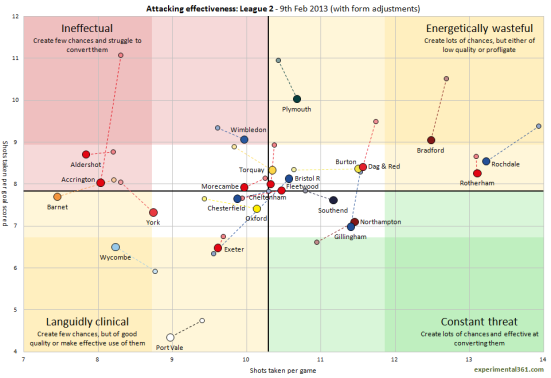
The Chesterfield match was a case in point: on chances created Oxford should have won that match with ease. Chris Wilder himself said afterwards that it should have been 5-1 at half-time, but we were let down by wasteful finishing. Chesterfield won on Saturday because they converted the one chance they created and against an Oxford side which simply cannot finish their chances, that is all our opponents need to do. Again this is nothing new, we've been complaining about this same problem for a while now and it isn't being put right. As this graph from the excellent Experimental 3-6-1 shows, we are decidedly middle-of-the-road when our goals-to-chances ratio is compared to the rest of League Two:
Picture from Experimental 3-6-1
This brings us round to another oft-raised point, which is the absence of any specialist coaching for the strikers. Chris Wilder, Mickey Lewis and Andy Melville might well be very good coaches, but they were all defensive players and have brought with them that defensive expertise. Is it so surprising that our strikers couldn't hit a barn door when the people coaching them on it were never trained in it themselves?

Unfortunately, these issues have never been addressed, despite being painfully apparent for quite some time, and it now seems obvious that they won't be addressed as long as Chris Wilder is the manager. This isn't a call for his head, but simply a statement of what appear to be the facts. Speculation has been rife for quite some time that Wilder will be replaced as manager in the summer, but whoever is in charge next season needs to look at this as their first priority. Find ways to beat defensive sides at home and be more clinical in front of goal.

Of course, that is just my opinion. Here are a range of other opinions of why Oxford have struggled at home this season.


What's you opinion? Leave a comment!

Share this

Wednesday, 27 February 2013

In Support of Chris Wilder

It's not exactly been a vintage year for Chris Wilder, with promotion plans going drastically awry and the support of a large section of the Oxford United fanbase drifting away. Saturday's goalless draw at home to York was met with yet more calls for the manager's head and chants of 'Wilder out' after the game. But Wilder still has his supporters and Richard Hanna believes that he deserves our support.

So exactly what sort of a manager do we have on our hands? Is Chris Wilder the same as he was the day he walked in to the club as a relative unknown and quickly turned our fortunes around?

I believe he is all that and a whole lot more.

I use Twitter a lot and always try to be positive when tweeting about Oxford United. It’s a very instant format and it's easy to vent spleen when things are not going well. I don’t blame other fans for doing it and won’t make an apology for doing it myself sometimes.

The beauty of social media is that opinions and thoughts can be shared straight away and during live events it can really contribute to the event itself and for those involved. However the flip side I believe is that when things go bad the negative tweets start and texts to radio stations come in and it’s very easy to get that bandwagon rolling and others will quickly find themselves jumping on it. I have noticed that football phone-ins and Twitter is a lot more lively when Oxford lose than when Oxford win. I have decided that ‘no views is good views’. I always try to be positive however I have been accused of giving ‘blind support’ to our manager.

That led me to think about why I do actually give my support, blind or otherwise.

I wrote a piece back in May last year on a very similar subject and don’t want to repeat myself and so will concentrate on what Chris Wilder has achieved this season. It may look at best mediocre but if I could point out a few highlights maybe you will be able to be a bit more positive about the 12/13 season. Bearing in mind there is still 14 games to be played out.

Firstly, we won the opening three games of the season, a great start for Oxford United.

Before the season really got started we had beaten League One Bournemouth in League Cup setting up a tie versus Leeds United.

Chris Wilder has so far been nominated three times for Manager of the Month awards, he may not have been given award but to be considered by people in the games says a lot.

From the 20th November Chris Wilder’s team embarked on a ten-game run of unbeaten matches, scoring 19 goals and ensuring all Oxford fans could have an enjoyable Christmas period (gold dust to long-suffering fans).

Along with the two League Cup games we also enjoyed a run of four JPT games going out on penalties to Southend. But amongst those four games was a 1-0 win against Swindon Town; Chris Wilder has a 100% record when managing Oxford v Swindon. The fact that they were in a higher division this time just made it sweeter.

This season will also be remembered as the season we got to the third round of the FA Cup for the first time in ten seasons.

Chris Wilder has this season been able to give full debuts to Max Crocombe and Tyrone Marsh – something they will never forget and I am sure they will be forever grateful.

Talking about injuries and suspensions may seem like offering excuses for our dips in form but I do feel it’s worth just noting the key injuries (missed two or more games) to the squad that we have had: Clarke, Duberry, Davis, Whing, Leven, Craddock and Smalley. There's seven from memory, but look at the names and think about the types of players they are and the experience they have and contributions they make when fully fit. Leading scorer James Constable has been in and out of form this year, with two red cards (inexplicably v Wimbledon) and has missed seven games through that process.

Another big thing that Wilder has had to deal with as a man and as a man-manager was the passing of Mitchell Cole. I would have no idea what kind of an impact that would have on a group of young, fit footballers but if anyone heard Wilder's interview post-Accrington in the FA Cup they will know it had a profound effect on him as a person and I think he felt himself as a father figure to those footballers and he praised them and supported them as best he could. It should not go unnoticed that that sad passing occurred during our ten-game unbeaten run.

Rest In Peace Mitchell.

And although we have struggled in late January and February there are a couple of signs that we are beginning to rediscover some form with three games unbeaten; indeed our last ten league game form reads Won 4 Drawn 2 Lost 4 – it's as good as it is bad.

So there is a considered opinion as to why I offer my whole support to Chris Wilder, I don’t think this season has been all doom and gloom I don’t think Chris Wilder is destroying this club, I don’t think he is clueless or devoid of ideas and until that changes I will continue to support him.


Share this

Thursday, 21 February 2013

Something to be Proud Of

There's no doubting that this season has been a depressing one for Oxford fans. The club has stuttered through the season and we're now a full ten points off the play-offs with just 14 games remaining, our promotion hopes looking distinctly forlorn. Long, spirit-crushing winless runs, controversial signings and a ridiculous list of injuries have characterised the season and against this backdrop large numbers of supporters have begun to stay away as the good-feeling and momentum of just a couple of years ago begins to look increasingly like another false dawn.

But it's not all doom and gloom. Though this season can be considered a disaster in terms of the first team and financially, the club has made huge strides forward in other areas. Unfortunately these are the areas that we fans rarely get more than a glimpse of. And while it can be difficult to find anything positive to say while we're watching our side get effortlessly picked apart by Fleetwood bloody Town in front of barely 5,000 fans, I think it's important that we do take a moment to praise the achievements of the club in other areas and to restore some of our pride in Oxford United.

Because although the first team's disappointing efforts have drawn comparisons with the side that was relegated from the Football League in 2006, and although some of the doom-mongers will tell anyone and everyone that that's the direction we are heading, the club is actually in a vastly different situation now. Back in 2006 Firoz Kassam's systematic dismantling of everything that made the club a real football club – a community asset – was reaching its inevitable conclusion. The youth system which had produced some excellent local products in the 90s and early 00s lay in ruins, decimated by chronic neglect and underfunding. The club's community activities had shrunk to nothing and its reputation in the local area was at rock bottom.

When WPL took over the club they had essentially inherited a ruin of a football club – one which was staring non-league oblivion in the face. It wasn't just the first team that was in poor shape, the whole club had been reduced to barely a shadow of its former self. The easy option – and the one which the club initially seemed to be taking in the first season in the Conference – was to pump money into the first team and attempt to win immediate promotion. But that would only have been papering over the cracks, because all the damage that had been done elsewhere would remain unfixed. Instead the last five or six years have been a rebuilding job at all levels, a slow and steady process which is now at last beginning to bear some fruit.

For the first time in years we've seen some products of the youth team come through and impress, with Tyrone Marsh and Max Crocombe both looking promising in recent glimpses. Sure, we've had players like Aaron Woodley and Alex Fisher in recent years, but neither looked as promising as these two and neither really delivered in the end. But Marsh has already looked a real prospect, scoring his first goal for the club in the JPT against Southend, as well as impressing at Conference South level while on loan at Staines Town. He put in a man-of-the-match performance and then scored the winner in his debut against Bath City and has continued to feature prominently there. A bit of regular competitive football can only help his development. Crocombe has also found himself thrown into first team action this season due to the injury to Ryan Clarke and has acquitted himself very well there. Ian Lenagan even said at the fans forum that Crocombe might have been our number one choice for the rest of the season, if not for the fact that he is due to fly to Fiji in March with the New Zealand under-20 squad.

He's not the only product of Oxford's youth system getting international recognition. Youth teamer Marvin Ekpiteta has been called up to represent Nigeria at under-20 level as well. And another two of Oxford's girls Academy players, Laura Nichol and Ella Franklin-Fraiture, have also been rewarded with an international call-up. They have just spent the last few days at an England under-17 training camp at St George's Park – part of the preparations for under-17s European competition – and both featured in a 1-0 win for England against Wales.

All of this is a good example of the huge amount of work that has gone into bringing our youth system up to scratch in the last few years and bodes well for the future. The youth team have had a remarkable season, currently sitting top of their league after winning an incredible 13 consecutive competitive matches between September and December, as well as reaching the third round of the FA Youth Cup.

The continuing success of the ladies team is another example of the strides the club has been making away from the first team. They feature in the fourth round of the Women's FA Cup for the first time this weekend, as they play at the Kassam Stadium for the first time ever when Newcastle United come to town. They are top of their league this season, after getting promoted in style just last season, and have ambitious plans for the future. This is a side which didn't even exist just a few years ago, and the progress they have made has been little short of remarkable.

And, to cap it all, the club's community activity has earned it recognition from the Football League, with a nomination for Family Club of the Year and an Unsung Hero award for Community Officer Peter Rhoades-Brown. The Youth & Community Sports Trust has become a lot more visible in the past year as well, hosting a range of fundraising events, such as the recent Oxford United on Ice event to the upcoming Charity Breakfast.

What this shows is that there has been a considerable effort to build this club from the ground up, not just to create a first team. So things haven't exactly gone to plan for our League Two promotion hopes, but that's no reason to simply give up on the club altogether. We have a lot to be proud of and it's time we showed our pride.


Share this

Wednesday, 13 February 2013

Fans Forum Transcript 07/02/13

The annual fans forum was held on February 7th with owner and chairman Ian Lenagan. Below is a transcript of his presentation (italicised sections are from other speakers). Enjoy.

Welcome this evening. I'd like to say I hope you enjoy the evening, I'm not sure that I was looking forward to it with enjoyment but they're always good things, fans forums, we always get a lot out of them. It also gives me the opportunity to say something at the beginning, because this is my first fans forum where I've been in actual charge in terms of day-to-day, week-to-week running of the club, whereas before as an owner I am getting reported figures and what's happening as much as anybody else is.

The last six months have been quite significant for me, in as much as I've been up to my elbows in Oxford United and I've actually got to the point where I enjoy the game tremendously, not perhaps at Southend last weekend. But from being a bit of an absent fan in some respects – I enjoyed it but I never used to know the players – I actually know everybody now.

What I don't know is, I don't know many of the fans and sometimes I'm well aware of the fact that I give off an exterior view which is not involved, but believe me I am very much involved in Oxford United. In terms of my time, my effort, my commitment and my enjoyment of the players and what we do. Most of the staff who work for Oxford United know me quite well, the players know me but the fans don't. I hope tonight is one of the opportunities where I can say to you, I really welcome the involvement of the fans, at games or whenever I've gone to the bar afterwards – at away matches rather more than at home. But I would love to get to know more of you and you get to know me because you'll trust me more, you'll believe that I have the passion for Oxford United that so many of you have because that's evolved and developed during the last six months.

But what I can't do is, I can't be in the newspaper or on the radio or whatever every week, that's not my style. My style is to deal with the business and deal with it as well as I can and to support the team passionately whether it's home or away and I've probably come to enjoy that part of it far, far more than I expected I would. Whilst I can't say that I've been an Oxford United fan for 20 years, 30 years or whatever, I can tell you that I am very heavily involved in the team and I hope that you'll get to know me a little better and understand me a bit better because you then might appreciate some of the decisions that we're having to undertake on behalf of the club and the team and everyone else involved in this.

So tonight, as far as the fans forum is concerned, we're looking at a review of the last six months. I took over on July 13th, not a very auspicious day especially as it was Friday the 13th, but I took over then and I've been involved for the six months since and there's been a lot of not-so-good and there's been a lot of good as well. But today is about telling you about all of that, to be open and honest . You might not agree with many of the things that I've done – I hope you do. But we're here discuss all of the issues that you want to talk about. Nothing's off the agenda.

We'll talk about matters on the field first of all. If we talk about the first team, if this had been two weeks ago and we'd been two points away from the play-offs we'd have been in a far more positive frame of mind, but the one point out of the last nine has not helped matters and the fact that we're seven points away from the play-offs now is not quite as good as it was.

The issue that's dominated in the last six months is the issue of sack the manager or not and the issue of the playing squad and if that's good enough and whether we should buy more and where that sits from a financial view. Let me just comment on a number of those issues. I said very clearly what the objective as far as Oxford United is: my objective is to get Oxford United into the Championship within a five-year period. I said that the objective – and I stand by it – this year is a very clear target and that as far as the manager is concerned is to get promotion. That's what the club wants. An absolute minimum is to get into the play-offs and we looked as though a couple of weeks ago we might be heading in the right direction after a good run after some bad runs before.

So where are we? We're behind where I would like us to be and I don't want to make excuses in terms of bad luck or injuries or whatever, you know what the reasons are as much as I do. I do know that in terms of the squad, I inherited a squad that had a lot of long-term injuries in it and we've been gradually working our way out of that. I took the decision back in October that we would wait for that situation to resolve itself, once we started to get players back, and then see what the result was.

Why did I make that decision? That was my decision and I don't think it was the wrong decision. I'm not saying there aren't other decisions that could have been taken but that was clearly my decision at the time. I took a view that said if we brought in a new manager, for example, at that time , with the injury load that we've got, that I wasn't convinced we could do a great deal about it anyway in terms of turning around the performance. And because the opportunity isn't there at that point in the season to replace half of the squad. And it would have been costly. It would probably have cost around a quarter of a million pounds to get rid of the manager and replace him with another one and pay the compensation that's involved and then you have to change players.

So I took the view that we owed a loyalty to Chris Wilder, that he has done well by the club and that we would give him the opportunity for the players to come back from injury and see what we could do then. And that nearly proved to be the correct view a couple of weeks ago, we'll see if it proves to be correct at the end of the season but that is my responsibility. I'll carry the can as far as that decision is concerned.

The issue in terms of what falling attendances would cost compared with what compensation would cost is about the same. It costs us somewhere between £200k-£250k if we have attendance that are 1,000-1,200 lower than what there would be. So it wasn't in the end a financial decision, it was a decision taken along the lines of when we've got the squad back and then we'll see what we can do. When we have the full squad available, or 90% of the squad available, because you can never have all of it, then we have a team that's more than capable of competing with anyone and for those of you who, like me, were at Bradford you'll understand that. And there's no doubt at all that if we can have our team out on the field most of the time we would be very competitive in this division which is in itself a competitive division.

But things happen. The goalkeeper getting both of his shoulders done was unfortunate when it occurred, Peter Leven and his problems with his knee was unfortunate and he's going to be out for another eight weeks, maybe ten weeks. And of course we have to deal with the issues of where do we get a creative midfielder, which Chris Wilder and myself are very, very heavily involved in, because we've committed the money to do that, yet more money to cover injuries but you haven't got a chance other wise. You can't compete and have whatever outside chance we have of getting in the play-offs without a creative midfielder and hopefully within the next ten days or so we'll see that gap plugged. We can't plug it until a week next Friday because if we do with the 93-day rule that applies in terms of transfers and if we got into the play-offs that player would then not be able to play in the play-offs, so we won't see anything happening until next Friday, is that the 14th, I'm not quite sure what the date is, but that's the salient date in order for the 93 days to allow you to be in the play-offs and we haven't lost sight of the fact that's what we want to do.

If we look at the playing squad in terms of Oxford United we look to have a squad of 21-22 players, plus whatever youth team players are deemed suitable to play, or be around on the bench or fill in if necessary. For the majority of this season we've had two-thirds of those available at best and that's been a real problem.   

We brought in Justin Richards on loan recently, before we signed him, and we needed him to fill in the Constable area. Every time you do something like that you have to remember the salary cap and the fact that it takes good money. We have never once not spent the money, we've spent it judiciously and carefully and we've looked to get the best deals that we always can when doing that, but not once has the manager ever been faced with the prospect of not being able to bring in the next players that are necessary.

So I hope never, ever, ever to go through a season where we start the season with so many crippled players before we actually get to the first game of the season and I can give you my assurance that that's not what we're going to do next term. And we're fortunate that there are quite a lot of people – particularly the expensive people – who are out of contract at the end of this particular season. And we've already started looking forward in terms of the players that we need who are fit and will stay fit moving forward. So with the investment that we've made in the backroom staff as well, we'll have a first team squad as fit as possible. You'll always get injuries, it's not unreasonable to have 10% injuries, but when you start off with 25% injuries then you give yourself something of a handicap.

But in terms of the playing squad itself and the first team, we're still stumbling by because we've lost our number one goalkeeper and we've lost our creative midfielder, we have people like Liam Davis with perennial problems with his hamstring, we've got Jon-Paul Pittman not yet back and unlikely to get back for most of the season, you know what they are as well as I do. But I'm intimately involved day-to-day and week-to-week trying to plan, within the financial constraints of the salary cap.

We don't have to stay within the salary cap. That's how the Swindons and the other clubs of this world get around the salary cap, but good management says stay within the salary cap, that's what the salary cap is all about, it's a guideline and it's a level which says 'this is the level beyong which you shouldn't go' and I have always worked on the basis that this is a level we should not go beyond. But there are times – and at the moment we're very fortunate that we've just had a donation from the 12th Man organisation, which will allow us very easily to bring in the next creative midfielder and pay for that for the next three, four months or so. We could put a donation of £100k into the football club, which is a way around the salary cap and the way that other people do it, but all you'd be doing is spending more on wages than you should. So when you see me talking about the salary cap and saying we can't go beyond the salary cap, there are ways of getting around the salary cap and we choose not to do it because it's bad financial management to do that.

And Oxford during the course of the last three years has gone from spending £950k on basic players' wages to £1.4 million, which is what it is now. We didn't budget to spend that much but there's an extra £200k in there in each of the last two years because of injuries and having to bring in emergency loan players and all sorts as cover.

So in terms of the first team squad that's all I'll say until further questions, apart from one issue, which is Luke McCormick, which has resulted in quite a lot of emails to me personally and quite a lot of different views as far as that is concerned and we're here as a board of directors tonight to justify the decisions that we made or at least explain them if anybody wants to question us. I think my position is very clear but I thought it might be quite useful because you don't know the other two board members . Adrian, would you mind commenting on the board's viewpoint on the McCormick issue?

Adrian Lenagan: We had a very long discussion for several hours concerning all the issues between the three of us and from the beginning one thing was clear. It wasn't a football question and it wasn't a financial question, it was unquestionably a moral question. And I suppose it's a tragic fact really that situations occur when ordinary people make terrible, terrible misjudgement which have lasting ramifications and this is clearly one of those instances. But then if you ask a group of people such as those here today what you should do when someone has served their sentence, paid their debt, whatever you want to call it, you're going to get as many different answers as you can possibly think of. It's clearly a hugely emotive issue and the validity of people's emotions is not to be questioned – how you feel is how you feel and that's really your own business.

But I think that we three obviously don't subscribe to the view that says that society should forget about a certain group of people, they've had they're opportunity and that's it. We do believe that people deserve a second chance and we have to stand by that decision and that's what we did.

Thanks for that Adrian. So it was a decision that we took in the full knowledge of the fact that a certain percentage of the Oxford fans would perhaps be passionately against it. But equally there could be another group of fans who supported the moral view that we took, the view that people should be granted another chance. A lot of people get praised  for making that sort of decision; I was interested to see that Richard Branson had put out an edict for the Virgin companies that they should employ ex-offenders and give them another chance. That's what we've done. We don't expect everybody to agree with it, I have no problem with the emails that I have received from people who passionately believe in the other direction, but that's why we took that particular decision.

In terms of the management and the backroom staff, I've talked about the manager's element of it. I think we're in a good position now with backroom staff particularly as well as the manager, with Andy Melville, Mickey Lewis and Chris Wilder – whether you think Chris Wilder should be there as manager or not, I think he should be at the moment, he gets his chance to do that – but I think that that group, particularly the two assistant managers, have come on in leaps and bounds in the last few years.

I'll introduce some people who you may not know; Alasdair Lane is our strength and conditioning manager, Dan Bond who has shown amazing commitment to the club in the last six months in working in a completely new area which is video analytics. Oxford United, you may not know, are clearly the leader in Leagues One and Two in the use of technology in sports science and the development within the football club. We've even had Premier League people come looking at what we do here in the Academy and with the first team squad and you should be immensely proud of where Oxford United is.

But we won't see a great degree of benefit of that for 12 months, that's the unfortunate thing. There's no quick fix, but in those people – and I include Andy Lord the physio and the doctors who stand in – we have a great backroom staff capable of taking us well beyond League Two and I'm proud of them and I'm delighted with the way they've taken up the cudgel and taken up the challenge in the last six months. And if any of you get the chance to go onto and look at the websites and what it is that we do in analytics and sports science you'll be very proud of your club, because I am.

We've always seen the youth team as something that's undervalued and underplayed at Oxford – probably because the previous owner decimated it for so long and by the fact that we allowed Oxfordshire-based to kids to move on to other clubs rather than through Oxford United.

I am particularly pleased with the fact that Ty Marsh and Max Crocombe have both played at least once for the first team this season and, to be frank, if Max hadn't been called up for the New Zealand squad for the four weeks that he's likely to be off in March we probably would have stayed with Max Crocombe as the goalkeeper for the next 12 weeks. But that's a very difficult decision, one which Chris Wilder would not necessarily agree with because if we're going to fight for the play-off places we need to have an experienced goalkeeper. On the other hand, I might have a view that said we have to give the young players a chance and somewhere between the two is what we've got. It's interesting that Ty has just gone off and got the man of the match award in a lower level game last weekend.

And because of our injuries there's no way that we can organise behind-closed-doors friendlies for the first six months of the season because we couldn't risk another injury, could we? And that's the problem, we can't even play them so someone like Max Crocombe can't seriously be thought of as a stand-in goalkeeper because he hasn't played a game for six months. That's the sort of problem that's been a perennial problem as far as Oxford United are concerned, but I guarantee you that problem is solved now.

One of the areas that we are investing in heavily is the whole youth structure and it's nice to see Richard Blackmore here tonight, for example, who does so much in the background at Oxford United and you should give him a big thank you, that's for sure, in terms of how the Academy is developing, how the ladies are developing and how the education side of the club is developing.

But we are committed to bringing young players through. That is probably one of the most important principles of the way the Lenagans approach Oxford United. The young players like Tyrone and Max will be able to stay with us from League Two to League One to the Championship, hoping that we do get there. Whereas if you've got to go out and buy players every year as you move from League Two to League One and then from League One to the next one, that's an ongoing problem where you're only as good as the players that you buy in. Whereas if you develop your own players you've got a much, much better chance less expensively with a much greater commitment.

I spent three quarters of an hour with Ty Marsh on Monday, talking about the next three years and we have an option for the next few and we're taking those options on. But we want to sign those young players for the next three years at least going forward, speculatively even because if we're not sure about them we'll still sign them on because they're the future of Oxford United.

The fact that they've done so well this year in terms of the FA Cup on the youth side of things is great. The fact that we've got a number of players – five, six, seven of them – who we think could challenge in a year or two years time. The fact that we've got the development squad being put together and the accelerator squad to take young players forward, both physically and in terms of their skill, that's where a lot of effort, money, time and commitment goes in as far as Oxford United are concerned.

You heard me use the phrase 'development squad' there, for example. We've never had a development squad. Again, because this is not just me, the other directors – Simon, a comment on the development squad?

Simon Lenagan: I think all of you appreciate that there is a gap between playing in the youth team and playing in the first team. We're aware of that and we think that the creation of the development squad, which is essentially taking youth teamers and combining them with people that we're not quite sure about, people who we traditionally would have let go. Being able to hold onto them, keeping them together as a group and giving them an extra year and allowing them to play 14-16 games perhaps across the season arranged by us behind closed doors against professional opposition in the local area – we think with the right development it would take and fly.

The problem with taking Max and Ty and expecting them to go and turn it on like that with them not having played enough will go next year, because they will play in the development squad 14-16 times throughout the season and they'll be much more ready. It'll also allow us to put into that development squad, because you can have a number of players who are above the age group,to play some younger pros in there and mix the culture of both and allow us to see which ones can move on.

It's a very important stage between the first team and youth team – it's not a reserve team, it's about development, it's about seeing how they grow and how they go after they leave the youth team. Or if they're in the second year of the youth team and we think they are ready, to see them play at a higher level that's not first team football. It's really important and I'm really glad we're going to get to do that next year.

But that will cost us £100k, for example. That's £100k of development cost, but if Oxford United doesn't do that we'll never have the young Oxfordshire players coming through into the team. And it'll take three years before you see the benefit of that. And in the background, whilst we're trying to get promoted this year and we are trying to do all the other good things that you are naturally very concerned about, we are spending an enormous amount of time and effort trying to get the basics right, but the futuristic basics. Nobody's got a development squad at our level, nobody's running the football squad software at our level, we're the only ones in League One and League Two that are actually doing that. We're way ahead on some of those things but you won't see the benefit of it for a while. But I think it's important that you can see some of the jam of tomorrow while looking at the mess that we've got in certain areas at the time. Hopefully we'll see the positives of that.

The Academy – and it's confusing because we talk about the Education Academy and the Academy as being the scholars which used to be the whole Centre of Excellence concept. They've all been renamed as Academy now so the under-9s right the way up to the youth team, the 19-year-olds, that is the Oxford Academy. And Oxford United Academy has actually achieved Category Three, not Category Four as most League Two and League One clubs are getting, but Category Three in the evaluation that's been done by the Premier League and the Football League in terms of how we develop young players. And that's a good position to be in as well, apart from our facilities – and our facilities down at Horspath are excellent and that issue will come up later on as well.

The ladies team: the ladies are actually playing on February the 24th at the Kassam. We're using one of our two matches that we're allowed to play to let the ladies team play against Newcastle United Ladies, who are two divisions above us, they're step one where we're step three, but we've already beaten one step one team in Charlton to get to where we are. But I would ask that you come along on that Sunday at one o'clock. Watch them play here at the stadium and be proud of what they've done, because if they win that game against Newcastle they will play against one of the eight elite Super League teams and that's a great position for Oxford United to have got to and I hope you're proud of them in the way that we are.

If we look at off the field. Well, that’s not been a very good year, I have to say, from a monetary viewpoint and an investment viewpoint.

I thought it would be useful for you to know when we identified that there was a financial problem, because you know the amount of money that we’ve had to put in during the course of the last seven or eight months or so and it’s quite substantial. The problems last year – that’s the year that finished in June of 2012, the season before this current season. I was at the fans forum here as the owner in March of 2012 when the loss for the year was being projected as £210k. That’s what the projections were of the loss for Oxford United for that year. By June, when I was starting to get involved in rather more detail, you could see it had gone up to £660k and for that year now it’s looking like £750k loss in that one year. That’s why I’m the chairman and chief executive of Oxford United, because you can’t afford to allow those kind of losses to continue and a lot of things had gone wrong at that particular point in time financially.

So that’s where most of the money has actually gone in during the course of the last six-to-nine months, it’s paying off a lot of things from last year. A lot of my efforts have been involved in correcting those mistakes and we’re coming out of that now – not without cost, unfortunately, our cost.

But again in June of 2012, six months ago, having been projected in the budget a £40k profit, it was apparent in June of that year that the projected loss was either going to be £250k or £425k, depending on who you listened to. Either of them were not good. Some of it was out of our hands, like the Football League’s commercial drop in income, which was poor. Some of it was in our hands; £200k of it is overspending on players - £300k at a push. If you’ve got a budget of £1.1 million you shouldn’t spend £1.4 million and you certainly should know it’s going to happen.

That’s what it looks like to me now in February 2013 in terms of what the loss will be this year and that’s where the money has had to come from to pay for all of that, for the problems of last year and problems with injuries and falling attendances into this year. Now you might say, ‘last week I said £825k’. I did, last week, but we put another £125k in on Monday because the attendances are down, because we’re having to pay more for salaries for players and because the betting stuff that the Football League said they were going to deliver haven’t been delivered. They’re things that happen with football clubs unfortunately and you have to grin and bear it – you as fans have to grin and bear it and we as owners have to grin and bear it, we don’t enjoy it but we’ve worked damn hard to turn it round and change it. And you’ve seen what will happen if we don’t manage it properly, with people like Swindon. Swindon were looking archetypally perfect in terms of going up through the leagues until you actually see the reality of what overspending can actually cost.

So balancing the cost against your income – and I’ll come back to that issue in terms of next year because before you buy your season ticket you might like to know what’s going on in terms of wages next year, that makes a big difference in terms of how good the team’s going to be next year. I also have to ask the question myself of what are the attendances going to be? Are we a 7,000 average attendance club or are we a 5,500 average attendance club? And I’ve got to second-guess that for next year, in terms of deciding what we do from a financial viewpoint. The answer is if you’re winning you’re a 7,000 average attendance club and if you’re not you’re a 5,500 or maybe even less – sales of tickets for this coming weekend are pretty awful. Nut the economic situation is difficult, the McCormick issue might be putting people off, the seven points away from the play-offs might put people off but I’d like to debate the question of what do we spend on wages next year in the next few minutes.

That’s where the £1 million has gone, it’s gone to pay off debts – we had £200k worth of loans that I didn’t know about that we’ve had to pay off over the course of the last 18 months and I don’t believe in being in debt. That’s one source of it, but there are others.

We’ve way overspent on injured players, having to bring in players. I don’t mean the Michael Duberry type position, which was a complete misfortune that in the close season he got a problem with his neck sleeping in his bed at home, that’s the kind of situation where you have to bring in a Michael Raynes and carry the cost of doing that. But it’s all the other stuff that has been over-the-top.

Again we couldn’t do a lot about Firoka and the fact that they charge and charge and charge for everything, much as we negotiate it down. They’re property people, that’s what they want to do, they want to make money out of the property.

We’ve lost £100k in the commercial arena by not meeting our forecasts last year, where the forecasts were just unreal or unrealistic for the business that we could do from a sales viewpoint. We now have far more realistic forecasts. I’m not saying that was anybody’s fault, because it’s very difficult to reduce forecasts, but you have to be realistic in the way that you look at it.

Attendances cost us £200k because they’re down below where they should be.

£100k on the community. We built up a debt of £100k by not paying people for the community operations. We’ve paid that off in one fell swoop, so that’s £100k wiped out. And now that business is developing extremely well. They’ve got a salesperson of their own and Richard driving it forward, so we’ve got a good base going forward.

That’s all negative, but the positive is the cup runs secured another £300k extra, because we budgeted not to get beyond any level in the cups and by getting through in both of the cups that’s what it meant, it meant over £200k of additional income, most of which was spent on players and other things as we go forward.

So that’s the financial position as far as the club is concerned. It’s been a difficult 12 months, it’s been a disappointing 12 months, but I am completely confident that we know exactly where we are. We bridged the gap because that’s our problem to do that and in that respect you haven’t got anything to worry about. It’s a soft debt and the club hasn’t any debt other than to Lenagans, none whatsoever. I don’t think there’s any more loans that can pop up from anywhere, I’m hoping to God there aren’t anyway!

Commercially, we have changes in commercial staffing. Owen Clark’s been doing a good job for us in terms of driving forward the commercial side of it, but we haven’t been able to address a lot of the requirements, particularly the requirements of marketing and commercial sales, because we’ve been too busy dealing with the ongoing problem of who’s doing what because of changes of management and everything else, but you’ll see an advert come out shortly for a sales and marketing director for Oxford United, because we have to get on the front foot in terms of marketing and everything. Where people like Chris Williams or Martin have been willingly covering the gap at the moment but we need to move forward now and we will see about doing that shortly.

Attendances are disappointing, but attendances are affected by the different problems we’ve had. By the economic situation as it is at the moment, by lots of matches together. We’ve been very unfortunate from the way the fixtures have actually dropped, we didn’t get a good fixture at Christmas and New Year in terms of being able to make money, it’s been a bit of a pain, I have to say, but I’m not surprised at where we are. I’m not blaming things on any of the Oxford fans, I’m praying and asking them, please come back and support because it does the team good as well as the finances good. But relative to £1 million it’s not that over-significant, the attendance drop – but then nothing is, compared to £1 million, is it? And I hop never to be there again with Oxford, that’s for sure. But attendances are what they are.

The training ground: we’ve had newspapers trying to say we’re going to lose our training ground and ‘did you know that Cowley Sports and Social have been given notice’ and whatever. We are very good at working with BMW in partnership and working with the local authority in planning forward future years to ensure that Oxford United maintain if not improve the level of training facilities that we’ve got and I am 99% confident that that will continue and that we will end up with better and better and better facilities in partnership with those two organisations. So we have no problem about the bowls club being given notice or the sports and social club who have been struggling for years and sadly they have to finish in 2015, but nothing’s at threat in any way at Oxford United.

Stadium issues: the non-issue of London Welsh was well publicised in the press a month or so ago. We get on extremely well with London Welsh, the chairman rang me up to apologise for the stories that had been run, for the fact that a loose conversation from an ex-employee of theirs had caused us some embarrassment. But the position as afar as the stadium is concerned is that Kassam is now getting twice the rental that he was getting from us before and there’s no way he’s going to sell the stadium to anybody so long as he’s getting £1 million a year of income. So it’s a non-event for at least the period until London Welsh either decide they’re here forever, or until London Welsh, God forbid, are unable to sustain themselves in the Aviva Premiership or financially. So we’ve marked time for at least 18 months.

We’ve been encouraged to actually set up a group of people, an advisory group, to help us look at all the alternatives around the stadium side of things and it’s quite likely we will do that in the near future. But there is no sharpness, there’s no immediacy. And you will recall that I said at my opening session that we don’t need the stadium and conference centre to be financially sustainable. None of this is dependent on the stadium or conference centre, the way we are. We can actually move forward through the leagues as a Football League club renting the stadium. But we’d like to buy it and I think that at a point in time that might be a possibility, but it’s less of a possibility now than it was 12 months ago – in particular because he’s getting twice the rental that he was getting before and the numbers don’t work at £13 million and we’re not going to buy it at £20 million are we? And if he’s getting twice the rental with the market as it currently is, that’s where we stand.

As far as the Education Academy is concerned, again Oxford United has an Education Academy with all these people in and we have the youth team going through advanced apprenticeships and gaining qualifications. But in addition we believe that Oxford United is in a position to get 16- and 17-year-old from Premiership and Championship clubs, so we’re attracting them to Oxford via education. So we’ve got a one-year under-17 group of people who are ex-Championship and ex-Premier League players who are not getting contracts at that higher level and who want a second chance. And the second chance is that they do a year at Oxford United, they get qualifications whilst also trying to get into our youth team and get a contract at the club – that’s what the under-17s are for. The semi-elites, the 16-19-year-olds – we have 50+ of those – go on to education and BTECs, level threes, that earn income for our club, give us jobs for our coaches and spread out into the community every year over 50 young men and girls who are committed to Oxford United and may play for other clubs, whether it’s North Leigh or Woodstock or wherever. And finally the developmental squad, which Simon’s already talked about.

And now it’s time for questions…….. 

Q & A to follow...maybe.


Share this